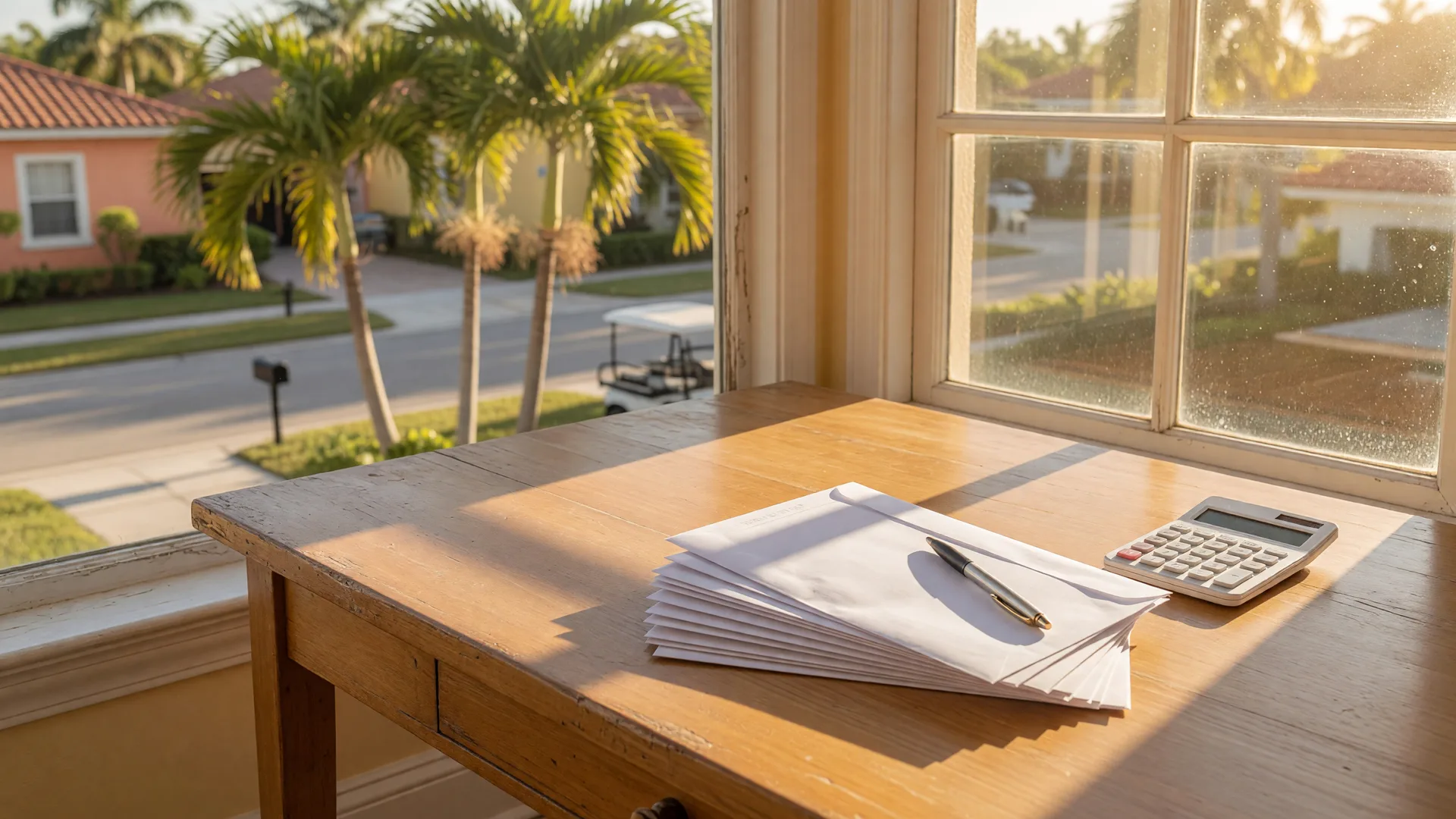

Every year around this time, homeowners across Southwest Florida see two things arrive together: the annual property tax bill and, in an election year, ballot measures that can change what future bills look like. This November, both are here at once. The 2026 tax bills for Collier and Lee Counties were mailed in the last week of October, the early-payment discount clock has started, and voters head to the polls tomorrow, November 3, on two statewide property tax amendments plus a Collier County tourism tax referendum. Here is what homeowners in Naples, Estero, Bonita Springs, Fort Myers, and Marco Island need to know right now, with links to the official county sources so you can check the details yourself.
The 2026 tax bills are in the mail, and the discount clock is running
Florida law requires tax bills to be mailed on or before November 1, and both counties are on schedule. The Collier County Tax Collector mails bills at the end of October, with online payment opening November 1. Lee County mailed its 546,481 tax bills on October 30, 2026, and bills can be paid online at LeeTC.com.
Both counties follow the same state discount schedule: 4 percent off if you pay in November, 3 percent in December, 2 percent in January, and 1 percent in February. The full amount is due by March 31, 2027, and unpaid taxes become delinquent April 1. Lee County adds that when a discount period ends on a weekend or holiday, the discount extends to the next business day.
What is on tomorrow's ballot for homeowners
Two statewide constitutional amendments on the November 3 ballot touch property taxes directly, and both need 60 percent approval. Amendment 3 would raise the homestead exemption for non-school property taxes to $150,000 in 2027 and $250,000 in 2028, indexed for inflation after that, and would lower the annual assessment growth cap for non-homestead properties (rentals, second homes, commercial) from 10 percent to 5 percent starting January 1, 2027. The measure also includes a residency requirement: someone who is not a Florida resident as of December 31, 2026 would receive the $50,000 exemption for the first four years before moving to the increased exemption in the fifth year. Whichever way you vote, it does not change the 2026 bills you are paying now.
Amendment 2 would exempt tangible personal property on agricultural land, such as farm machinery and equipment used in agricultural production or agritourism, from property taxes beginning with the 2027 tax year.
Collier County voters will also decide a county measure: the Tourist Development Tax referendum (Ordinance No. 2025-33) asks whether to raise the county's tourist development tax from 5 percent to 6 percent on short-term rentals of six months or less, including hotels, motels, and vacation rentals. It needs a simple majority, and if approved it takes effect January 1, 2027. The county describes the revenue as funding tourism promotion, beaches, parks and infrastructure, and the Paradise Coast Sports Complex.
The 2026 assessment appeal window has closed
The deadline to challenge this year's assessment has passed in both counties. Collier County mailed its Truth in Millage (TRIM) notices the week of August 24, 2026, and petitions to the Value Adjustment Board were due September 11, 2026. Lee County mailed its TRIM notices on August 17, 2026, with the same September 11, 2026 petition deadline.
If you believe your 2026 assessed value was wrong, the time to petition is over, so the next opportunity comes with the 2027 notices, which arrive next August. If you have a question about how your value was set, your county property appraiser's office is the place to start, and it is never too early to ask what to expect.
Homestead and senior exemptions: what applies for 2026
For the 2026 tax year, the homestead exemption is $25,000 against all property taxes, including school district taxes. On top of that, an additional exemption of $26,411 applies to non-school taxes. That second piece is adjusted for inflation each year under Amendment 5, which Florida voters approved in November 2024, and the Florida Department of Revenue certified $26,411 for 2026. Combined, the exemption totals $51,411 against non-school taxes.
Both counties also offer an income-based senior exemption for homeowners 65 or older. In Collier County it is an additional $50,000 off assessed value, with a 2026 household income limit of $38,686 based on the 2025 tax year. Lee County offers the same $50,000 additional senior exemption with the same $38,686 income limit, and a separate full-value senior exemption for owners who have lived in their home 25 years or more when the just value is under $250,000.
Senior exemption applications must be filed by March 1 of the qualifying year, and exemptions are not granted retroactively, so the date matters. The next deadline is March 1, 2027 for the 2027 tax year. If you turned 65 during 2026, or your household income dropped below the limit, that is the window to plan for.
The dates to save
- November 3, 2026: Election Day. Amendments 2 and 3 are on the statewide ballot, and the tourist development tax referendum is on the Collier County ballot.
- November 30, 2026: Last day to pay the 2026 tax bill with the 4 percent discount.
- December 31, 2026: The 3 percent discount period ends.
- January 31, 2027: The 2 percent discount period ends.
- February 28, 2027: The 1 percent discount period ends.
- March 1, 2027: Senior exemption applications for the 2027 tax year are due.
- March 31, 2027: The full 2026 tax bill is due, and unpaid taxes become delinquent April 1.
How I put this together
Every fact above is verified from official county, property appraiser, or tax collector sources for this tax season, and every link points to the county source so you can confirm the details yourself. I skip anything I cannot verify, and if a date or program changes, the county websites are the place to check the latest. This is general information, not tax or legal advice; your bill, exemptions, and appeal rights depend on your specific property, so your county offices are the final word.
A note on fair housing: every home and community in Southwest Florida is open to all qualified buyers and renters, without regard to race, color, religion, sex, disability, familial status, or national origin. Tax exemptions and relief programs are available equally to everyone who meets the published eligibility rules. If you are exploring a move here, I am glad to help you find the place that fits you, whatever your story.
A note from the author: I'm Catalina Quintero, a bilingual REALTOR with The Miranda Group at Premiere Plus Realty, Co., serving Naples, Bonita Springs, Estero, Fort Myers, and Marco Island. I publish this property tax update each season from current, published county sources so homeowners know what is due and what is coming. If you are thinking about a move, email or text me any time.
Thinking About Buying or Selling in Southwest Florida? Start With a Conversation.
Contact Catalina Quintero at (239) 206-6909 or use the contact page to schedule a consultation.